Introduction
An inspector doesn’t need to open your batch records to flag a Schedule M non-conformance. Sometimes it’s enough to run a hand along a workbench seam and feel a gap.
Under the revised Schedule M, notified by the Ministry of Health and Family Welfare vide G.S.R. 922(E), dated December 28, 2023, pharmaceutical furniture is no longer just a facilities purchase. Inspectors now judge workbenches, trolleys and storage against the same premises and equipment clauses as the rest of the room. The notification substituted the entire text of Schedule M under the Drugs Rules, 1945. It restructured the schedule into Part I (“Good Manufacturing Practices for Pharmaceutical Products: Main Principles”), followed by product-specific Parts for sterile products, oral solids, liquids and other dosage forms.
Below are the clauses that apply to furniture and equipment, where the compliance deadlines stand in 2026, and what QA, regulatory and procurement teams should specify before their next CDSCO inspection.
Table of Contents
- What Revised Schedule M Says About Premises and Furniture
- What Revised Schedule M Says About Equipment
- Why Stainless Steel Is the Default Specification
- Surface Finish: Make "Smooth" Measurable
- The Documentation Pack QA Will Ask For
- What Is GMP-Compliant Pharmaceutical Furniture?
- Compliance Timeline: Where Indian Pharma Stands in 2026
- Common Pharmaceutical Furniture Issues to Check Before an Inspection
- A Procurement Checklist for QA and Procurement Teams
- Furniture Is One of the Faster Schedule M Fixes
What Revised Schedule M Says About Premises and Furniture
Clause 12 (Premises) of Part I sets the baseline. Part I follows the structure of the WHO good manufacturing practices: main principles.
Three of its sub-clauses matter most for furniture:
- Clause 12.2.1: the layout and design of premises “must aim to minimise the risk of errors and permit effective cleaning and maintenance in order to avoid cross contamination, build-up of dust or dirt.”
- Clause 12.6.4: wherever starting materials, primary packaging materials or bulk products are exposed to the environment, interior surfaces (walls, floors and ceilings) “shall be smooth and free from cracks and open joints, shall not shed particulate matter and shall permit easy and effective cleaning and, if necessary, disinfection.”
- Clause 12.6.5: pipework, light fittings and ventilation points must be “designed and sited to avoid the creation of recesses that are difficult to clean.”
None of these clauses name furniture. Even so, a workbench in a production or QC area sits inside that surface environment. An open seam or unsealed joint on it creates exactly the kind of dirt-trapping recess the clauses are written to prevent. That is why inspectors apply the clause 12.6.4 standard to furniture surfaces in practice.
What Revised Schedule M Says About Equipment
Clause 13 (Equipment) fits pharma furniture more closely, because workbenches, trolleys and storage systems on the production floor are treated much like equipment. Clause 13.1 says equipment “must be located, designed, constructed, adapted and maintained to suit the operations to be carried out.” Its layout and design must permit “effective cleaning and maintenance in order to avoid cross-contamination, build-up of dust or dirt.”
Three sub-clauses matter for furniture specification:
- Clause 13.6: production equipment shall be thoroughly cleaned according to a fixed schedule.
- Clause 13.9: parts of production equipment that come into contact with the product “must not be reactive, additive or absorptive to an extent that would affect the quality of the product.” For furniture, this applies to surfaces where open product is handled, such as worktops in dispensing or sampling areas.
- Clause 13.10: defective equipment shall be removed from production and QC areas, or clearly labelled as defective.
Why Stainless Steel Is the Default Specification
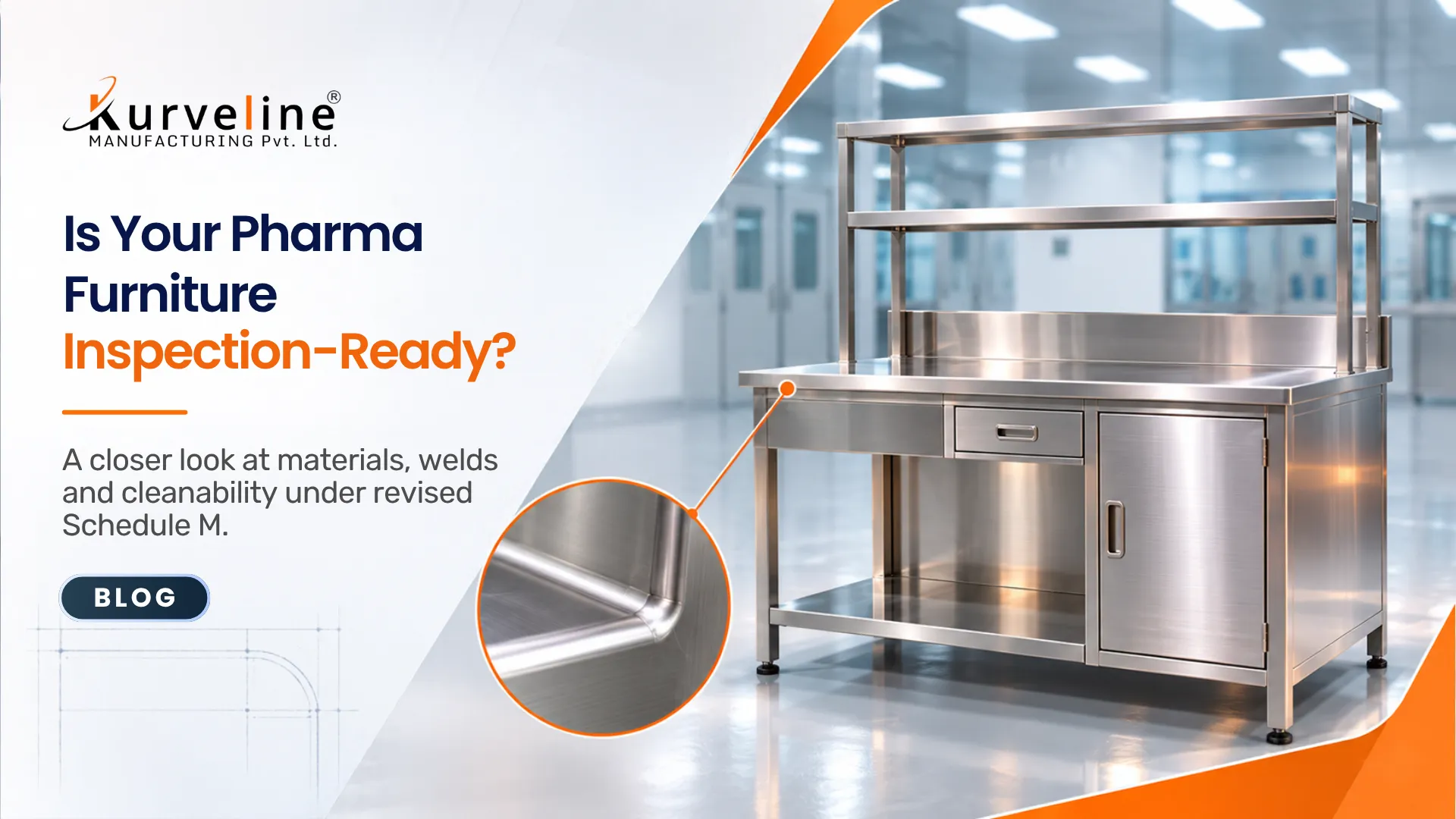
Stainless steel cleanroom furniture, usually 304 or 316 grade, meets both sets of expectations. It is non-porous and non-reactive, and it survives repeated cleaning without shedding or degrading. For SS pharma furniture, such as workbenches, trolleys, storage racks and pass boxes, the welded seam is what an inspector actually runs a hand along when judging the “free from cracks and open joints” standard. A bolted stainless workbench with an unsealed joint fails that test the same way a laminate one would.
304 vs 316: Choosing the Grade
Choose the grade by the cleaning regime and by whether the surface touches the product.
| Grade | Where it fits | Why |
|---|---|---|
| SS 304 | Dry cleanroom storage, non-contact areas, general QC furniture | Good corrosion resistance under routine cleaning, at a lower cost than 316 |
| SS 316 | Product-contact surfaces, CIP and wash-down areas, areas cleaned often with chloride-based or other aggressive agents, and coastal sites | Molybdenum in the alloy improves resistance to pitting from chlorides and harsh disinfectants |
| Electropolished 304 or 316 | Areas where the specification calls for the lowest practical surface roughness | Removes a thin surface layer, leaving a smoother finish that is easier to clean |
Unsure? Check the grade against the disinfectants listed in your cleaning SOP, especially chloride-based ones.
Surface Finish: Make "Smooth" Measurable
Clause 12.6.4 asks for surfaces that are smooth and easy to clean, but you can’t check “smooth” on delivery. You can check surface roughness, written as Ra and measured in micrometres (µm). A lower Ra value means fewer scratches and grain lines to hold residue and microbes. It also makes the surface easier to clean and disinfect consistently.
A practical way to specify it:
- Write one Ra limit into the purchase order for product-contact surfaces and a separate one for non-contact surfaces, rather than asking for a generic “mirror” or “satin” finish. Kurveline, for example, works to Ra ≤ 0.8 µm on product-contact surfaces.
- Ask for welded joints on contact surfaces to be ground and polished to match the surrounding sheet. Otherwise the weld line becomes the roughest point on the bench.
- Ask the vendor to measure Ra on delivery and record the readings, so the finish is documented rather than assumed.
The Documentation Pack QA Will Ask For
Furniture in a GMP area needs the same paper trail as other fixed items. A missing certificate can be as much of a finding as a gap in a weld. Before you place the order, agree with the vendor what the documentation pack will contain:
- Material certificates with heat traceability, so the stainless steel grade can be traced back to the mill batch
- Dimensional records against the approved drawing
- Surface finish (Ra) verification for contact surfaces
Then add your own records. These are a design qualification (DQ) against your user requirements, an installation qualification (IQ) once the furniture is in place, and an entry for each new piece in the cleaning SOP and schedule, so it is covered under clause 13.6 from day one. Keep the pack with your facility records and site master file so it can be produced during an inspection.
What Is GMP-Compliant Pharmaceutical Furniture?
GMP-compliant pharmaceutical furniture meets the cleanability standard the revised Schedule M sets for production areas. Its surfaces are smooth, non-porous and free from cracks and open joints, which is the clause 12.6.4 standard for room surfaces that inspectors also apply to furniture. In practice, that means fully welded and ground seams, a stainless steel grade matched to the cleaning regime, and a documented cleaning schedule under clause 13.6. Where an open product touches the surface, the material must also be non-reactive under clause 13.9. See how these points become a specification for GMP-compliant SS pharma furniture.
Compliance Timeline: Where Indian Pharma Stands in 2026
Revised Schedule M now applies to every drug manufacturing unit in India. The rollout was phased by manufacturer size:
- Large manufacturers (annual turnover above ₹250 crore) had six months from notification, with compliance in effect from June 28, 2024.
- Small and medium manufacturers (turnover of ₹250 crore or below) were first given 12 months. They then received a conditional extension to December 31, 2025 under G.S.R. 127(E), dated February 11, 2025. The extension applied to units that filed an upgradation plan in Form A with the Central Licence Approving Authority within three months of that notification.
- From January 1, 2026, the revised requirements apply industry-wide. No further extension is in force, and CDSCO and the State Drug Control Authorities are carrying out active inspections against the revised Schedule M.
If your facility hasn’t yet closed the gap on furniture and fixtures, the deadline has already passed for you, and an inspection can come at any time.
Common Pharmaceutical Furniture Issues to Check Before an Inspection
These furniture issues trace back to the clauses above. Check for them on a walk-through before an inspector does:
- Open or unsealed joints in workbenches and storage units (clause 12.6.4)
- Painted or coated surfaces showing chipping, rust or wear that create a particulate risk (clause 12.6.4)
- Product-contact surfaces made of materials not shown to be non-reactive (clause 13.9), or materials that degrade under the site’s cleaning agents
- Furniture left out of the documented cleaning schedule (clause 13.6)
- Damaged furniture left in production or QC areas instead of being removed or labelled (clause 13.10)
All five can be prevented when the furniture is specified and bought.
A Procurement Checklist for QA and Procurement Teams
Before signing off on a pharmaceutical lab furniture order, QA and procurement teams should confirm:
- The material grade (304 or 316) matches the cleaning agents and whether the surface touches the product (see the grade table above; clause 13.9 for contact surfaces).
- All seams are fully welded and ground smooth, not bolted or riveted. Crevice-free laser-welded joints are the practical way to meet the clause 12.6.4 “free from cracks and open joints” standard.
- The order states an Ra limit for contact and non-contact surfaces.
- The vendor supplies the documentation pack: material certificates with heat traceability, dimensional records and Ra verification.
- A fixed cleaning schedule for the furniture is defined and documented (clause 13.6).
- The furniture is specified for the room’s cleanroom grade, not chosen as a generic catalogue SKU.
Furniture Is One of the Faster Schedule M Fixes
Contamination control has always depended on surfaces that can be cleaned properly. The revised Schedule M makes inspectors check that, clause by clause, for the benches and cabinets as well as the walls. For manufacturers still closing gaps after the January 2026 enforcement date, furniture is one of the faster fixes available: it doesn’t need the lead time of an HVAC overhaul, but it does need the specification right the first time.
Kurveline Manufacturing provides stainless steel fabrication for pharma plants, including GMP cleanroom furniture, storage systems and fixtures. Welds are crevice-free and probe-inspected, the SS 316 or 304 grade is chosen for your cleaning regime, and material certificates with heat traceability are supplied for your QA file. Kurveline has supplied GMP-compliant pharma furniture to leading Indian and global pharmaceutical manufacturers.
If you’re reviewing your furniture against revised Schedule M, share your drawings or room specification and ask for a specification review.
FAQs
Schedule M is the part of India’s Drugs Rules, 1945 that lays down Good Manufacturing Practice requirements for pharmaceutical premises, plant and equipment. The version notified via G.S.R. 922(E) on December 28, 2023 restructured it around a Pharmaceutical Quality System, with detailed clauses on premises, equipment and materials.
Large manufacturers with turnover above ₹250 crore had to comply from June 28, 2024. Small and medium manufacturers that filed an upgradation plan under G.S.R. 127(E) had until December 31, 2025. From January 1, 2026, the revised requirements apply to every drug manufacturing unit in India.
The premises and equipment clauses in Part I don’t include a separate clause on furniture. Inspectors apply clause 12.6.4 (surfaces smooth and free from cracks and open joints) and clause 13 (equipment design, cleaning and material compatibility) to workbenches, storage units and fixtures in production and QC areas. Check the product-specific Part for your dosage form too, because inspection guidance for some dosage forms also covers furniture finish.
Stainless steel, typically 304 or 316 grade, is non-porous, doesn’t shed particles, and withstands repeated cleaning and disinfection. Where open product touches the surface, a suitable grade (often 316) meets clause 13.9’s requirement that contact parts must not be “reactive, additive or absorptive.” Fully welded stainless furniture also avoids the open joints that the clause 12.6.4 standard rules out.
Use 304 for dry storage and non-contact areas. Use 316 for product-contact surfaces, CIP and wash-down areas, and areas cleaned often with chloride-based disinfectants. The molybdenum in 316 gives it better resistance to pitting.
Schedule M doesn’t set an Ra figure. A practical approach is to write one Ra limit for product-contact surfaces and another for non-contact surfaces into the purchase order, and ask the vendor to verify it on delivery. Kurveline works to Ra ≤ 0.8 µm on product-contact surfaces.
Clause 13.6 requires that production equipment be “thoroughly cleaned according to a fixed schedule.” For furniture, this means a documented cleaning frequency and method, validated against the specific disinfectants used at the site.
Sometimes. Resealing joints or replacing worn fasteners can extend the life of existing furniture. Furniture with structural gaps, corrosion or materials that can’t be welded usually needs replacing to meet the clause 12.6.4 standard in a Schedule M audit.
CDSCO, in coordination with the State Drug Control Authorities, inspects manufacturing premises, including furniture, surfaces and equipment, as part of GMP compliance audits under the Drugs and Cosmetics Act.